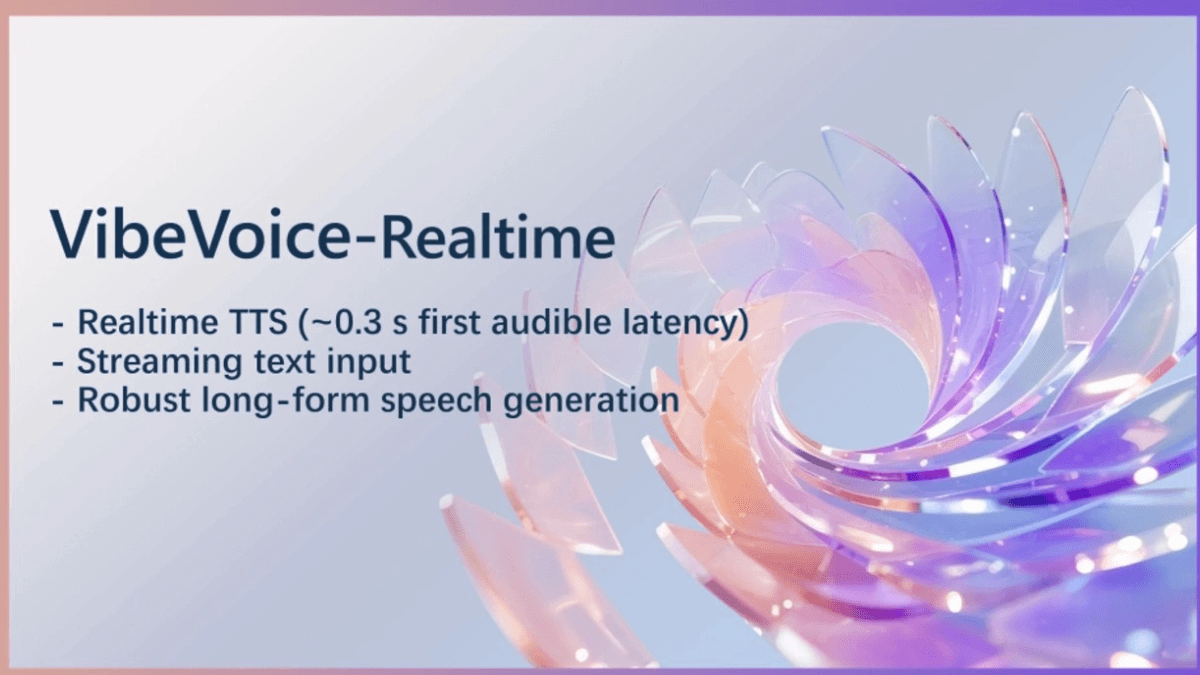
VibeVoice-Realtime - Microsoft open source lightweight real-time text-to-speech model

What is VibeVoice-Realtime?
VibeVoice-Realtime is Microsoft's open source lightweight real-time text-to-speech (TTS) model designed for low-latency and real-time interaction. Supports streaming text input from the first text token It can be vocalized at the beginning, and the delay is only about 300 ms, which is suitable for real-time broadcasting of dynamic data streams. The model parameter count is 0.5B, with interleaved windowing design, and low frame rate generation of high-fidelity audio through efficient acoustic splitter and diffusion decoder. It supports long text speech generation, which is suitable for news broadcasting, sports commentary and other scenarios. Currently only supports English and single-speaker speech, and embedded disclaimers and digital watermarks in the synthesized audio to prevent misuse.VibeVoice-Realtime is open source on Hugging Face under the MIT license, and is suitable for research and commercial applications.
Features of VibeVoice-Realtime
- Real-time streaming processingIt supports streaming text input and can start from the first token generated by the Large Language Model (LLM), realizing real-time speech output, which is suitable for real-time broadcasting of dynamic data streams.
- low latency: The latency of the model to produce the first audible audio is approximately 300 milliseconds for different hardware configurations.
- Long Text-to-Speech Generation: Can robustly generate long-form speech for scenarios that require continuous speech output.
- Efficient Architectural Design: An interleaved windowing design is used to incrementally encode blocks of input text while exploiting prior contextual information in parallel to continuously advance diffusion model-based acoustic latent variable generation. The semantic disambiguator is removed and only the efficient acoustic disambiguator is used, which runs at an extremely low frame rate of 7.5 Hz.
- Lightweight & Deployment Friendly: 0.5B parameter count, easy to deploy, and can be quickly integrated into a variety of applications.
Core Benefits of VibeVoice-Realtime
- Real-time streaming processingThe first token of the text input can start to sound, realizing real-time voice output and meeting the demand for real-time broadcasting of dynamic data streams.
- Low latency design: The latency of the model to produce the first audible audio is only about 300 milliseconds, ensuring a fast response and enhancing the user experience.
- Long Text Support: Robustly generates long-form speech for news broadcasting, sports event commentary, and other scenarios that require continuous voice output.
- Lightweight Architecture: The number of references is only 0.5B, and it is easy to deploy and integrate with an efficient acoustic splitter and diffuse decoding dock.
- high-fidelity audio: Supports 24kHz high-fidelity audio output for a high-quality voice experience.
- security mechanism: Automatically embeds disclaimers and digital watermarks in synthesized audio to prevent abuse and ensure safe use.
- Open source friendly: Open source on Hugging Face under the MIT license for easy research and commercial applications.
What is VibeVoice-Realtime's official website?
- Github repository:: https://github.com/microsoft/VibeVoice
- Huggingface Model Library:: https://huggingface.co/microsoft/VibeVoice-Realtime-0.5B
- Online Experience Demo:: https://huggingface.co/spaces/anycoderapps/VibeVoice-Realtime-0.5B
Who is VibeVoice-Realtime for?
- developer: Developers who want to integrate real-time voice functionality into their applications can leverage its open-source nature and lightweight architecture to quickly implement voice-over functionality.
- content creator: Real-time speech generation is needed to assist content creation, such as live streaming, video narration, podcast production, etc., and can enhance the interactivity and attractiveness of the content.
- business user: Enterprises that require low-latency, high-quality voice output in customer service, intelligent assistants, and information broadcasting can use it to improve service efficiency and user experience.
- research organization: Researchers focusing on speech synthesis, natural language processing, and other areas can use their open source models for further research and optimization.
- educator: The need for real-time voice assistance during teaching and learning, such as online courses, language learning, and other scenarios, can enhance the effectiveness of teaching and learning.
- Media & Journalism: Media organizations that require real-time voice broadcasting of news, sports events and other dynamic information can quickly generate voice content to enhance communication efficiency.
© Copyright notes
Article copyright AI Sharing Circle All, please do not reproduce without permission.
Related articles

No comments...
 English
  简体中文
简体中文  日本語
日本語  한국어
한국어  Русский
  Español