
TRELLIS.2 - Microsoft Open Source Large Scale 3D Generative Modeling

What is TRELLIS.2?
TRELLIS.2 is Microsoft's open source large-scale 3D generation model with 4 billion parameters, focusing on high-fidelity image to 3D generation. It utilizes an innovative "O-Voxel" sparse voxel structure that efficiently handles complex topologies and sharp features to generate high-quality 3D assets with full PBR materials. Models are supported in a wide range of resolutions from 512³ to 1536³ and can be generated quickly on NVIDIA H100 GPUs, e.g. 512³ resolution in about 3 seconds.
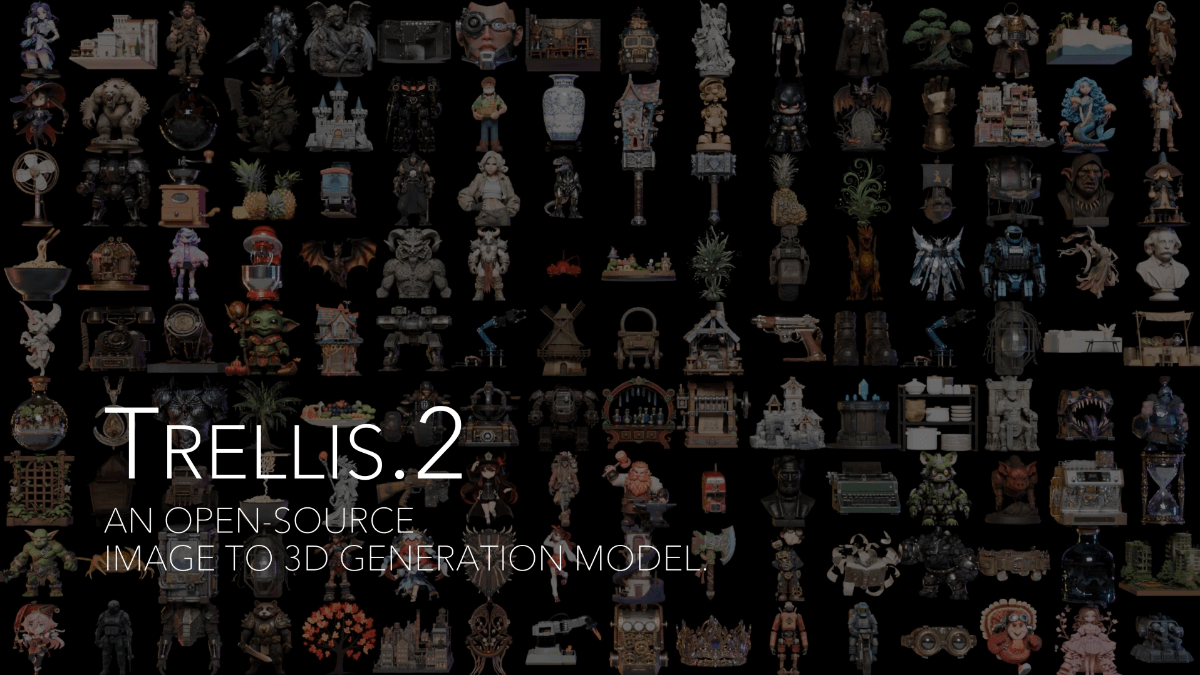
Features of TRELLIS.2
- High quality and efficiency: The 4 billion parameter model quickly generates high-resolution, fully textured 3D assets supporting multiple resolutions, with generation speeds that excel on NVIDIA H100 GPUs, for example, 512³ resolution in about 3 seconds.
- Complex Topology ProcessingThe "O-Voxel" sparse voxel structure, which can robustly handle complex topologies such as open surfaces, non-fluid geometries and internal closed structures, breaks through the limitations of traditional methods.
- Rich texture modeling: Support for base colors, as well as simulation of surface properties such as roughness, metallicity and opacity, support for transparency and photorealistic rendering, and generation of 3D assets with a high degree of visual realism.
- Minimalist data processing: The data processing process eliminates the need for rendering and optimization, and can be converted between textured meshes and O-Voxel in a short period of time, greatly improving processing efficiency.
- Open Source and Ease of UseThe MIT license is open source, supports Linux, and requires an NVIDIA GPU with at least 24GB of video memory. pre-trained models are available on Hugging Face for quick start-up and application.
Core Benefits of TRELLIS.2
- High fidelity 3D generation: Generate high-quality 3D assets with complex shapes and texture details, support multiple resolutions, and produce photorealistic results.
- Efficient Processing Capability: Using sparse voxel structure and optimized algorithms, the generation speed is significantly improved, e.g., only about 3 seconds at 512³ resolution, which is suitable for large-scale applications.
- Powerful topology adaptability: Breaking through traditional limitations, it is capable of handling complex topologies such as open surfaces, non-fluid geometries, and internally closed structures for a wide range of applications.
- Rich material support: Support for base colors, as well as the ability to simulate PBR material properties such as roughness, metallicity, and opacity, generating 3D assets that can be used for high-quality rendering.
- Minimalist Data Processing: Rapid conversion between textured meshes and O-Voxel without complex rendering or optimization steps greatly simplifies processing.
What is the official website for TRELLIS.2?
- Project website:: https://microsoft.github.io/TRELLIS.2/
- Github repository:: https://github.com/microsoft/TRELLIS.2
- HuggingFace Model Library:: https://huggingface.co/microsoft/TRELLIS.2-4B
- arXiv Technical Paper:: https://arxiv.org/pdf/2512.14692
- Online Experience Demo:: https://huggingface.co/spaces/microsoft/TRELLIS.2
People for whom TRELLIS.2 is intended
- 3D artists and designers: It can quickly generate high-quality 3D models to help them iterate their designs quickly, save modeling time, and improve creative efficiency.
- game developer: Suitable for game development scenarios that require rapid generation of complex 3D assets, it can generate high-resolution 3D models with rich materials to enhance the game's visual effects.
- VFX Team: It can be used to quickly generate realistic 3D scenes and props, and supports a wide range of materials and textures to meet the demand for high-quality 3D content in film and TV production.
- Virtual Reality (VR) and Augmented Reality (AR) Developers: Generates high-fidelity 3D models suitable for VR and AR applications, enhancing immersion and user experience.
- Artificial intelligence and machine learning researchers: As a powerful 3D generative model, it can be used to study 3D generation techniques, model optimization and new algorithm development.
- Educators and students: Provide tools for teaching and learning in related disciplines to help students quickly master 3D generative techniques and explore applications of 3D modeling and rendering.
© Copyright notes
Article copyright AI Sharing Circle All, please do not reproduce without permission.
Related articles



No comments...
 English
  简体中文
简体中文  日本語
日本語  한국어
한국어  Русский
  Español