
Koina - Decentralized Machine Learning Platform Open-Sourced by TU Munich and U of Michigan

What's Koina?
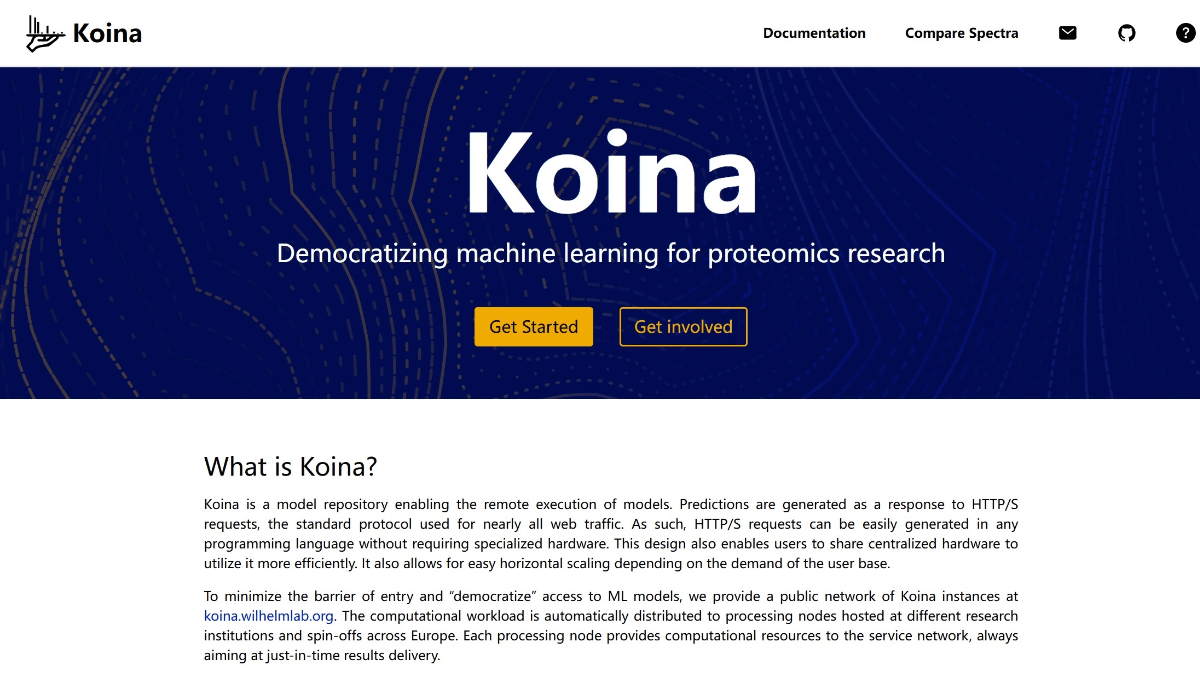
Koina is an open source decentralized machine learning platform focused on simplifying proteomics data analysis. Developed by a team from the Technical University of Munich, Germany and the University of Michigan, USA. The platform integrates more than 30 mainstream models (e.g. ProSIT, MS²PIP) through a standardized interface, supports peptide mass spectrometry prediction, retention time calculation and other functions, and can seamlessly access FragPipe and other analysis software. The feature is the provision of public server network and local Docker deployment solution, which solves the model compatibility and data security issues and significantly reduces the technical threshold of proteomics research.
Features of Koina
- Remote Model Execution: Supports remote access to model prediction results via HTTP/S requests without local hardware support, convenient for different programming languages to call.
- distributed computing network: Relying on processing nodes at research institutes across Europe, computational tasks are automatically assigned to enable rapid results delivery.
- Open source and community driven: Fully open source, community participation is encouraged to contribute, users are free to give feedback and participate in project improvement.
- Flexible deployment options: Provides both public network and local private deployment to meet different data security needs.
- Multi-language client support: Python and R client libraries are provided for easy use in different programming environments.
- Specialized in proteomics: Mainly used in proteomics, such as spectral library generation, peptide identification, etc., to enhance the efficiency of analysis.
- Scalability and Multi-Domain Support: Expansion into areas such as metabolomics is underway, and more domain models may be supported in the future.
Koina's core strengths
- Efficient Distributed Computing: Through a distributed network of nodes, the computational tasks are allocated quickly, which significantly improves the efficiency of the model operation.
- Cross-Language Universality: Support for multiple programming languages through the HTTP/S interface call to reduce the technical threshold and improve ease of use.
- Flexible deployment options: Provides both public network and local private deployment to meet different data security and privacy needs.
- Open Source and Community Support: Fully open-source, community-driven, with free user contributions and feedback, continuous optimization and extended functionality.
- Multi-language client integration: Provides multi-language client libraries in Python, R, etc. for easy integration into existing workflows.
- Model dynamic management: Supports dynamic loading and management of multiple models, facilitating rapid switching and updating to adapt to different application scenarios.
- Focus on specialized areas: Deeply optimized in specialized areas such as proteomics to provide efficient and accurate model predictions.
- Data security and privacy protection: Ensure data security and privacy during transmission and storage through encrypted transmission and local deployment.
What is Koina's official website?
- Project website:: https://koina.wilhelmlab.org/
- GitHub repository:: https://github.com/wilhelm-lab/koina
- Technical Papers:: https://www.nature.com/articles/s41467-025-64870-5
Who is Koina for?
- Bioinformatics researchers: Focuses on proteomics, metabolomics, and other areas of research that require efficient processing and analysis of biological data.
- Data Scientist and Machine Learning Engineer: Desire to rapidly deploy and use machine learning models without local hardware support and improve development efficiency.
- Laboratory technicians: There is a need to integrate advanced machine learning tools into existing experimental processes to improve data analysis and experimental efficiency.
- software developer: Quickly integrate machine learning functionality into your own software projects through Koina's multi-language client and API interfaces.
- Academic institutions and research teams: The hope is to utilize distributed computing resources to reduce research costs and accelerate the progress of research projects.
- Corporate R&D Team: The need to quickly validate and apply machine learning models to improve the intelligence of products and services.
© Copyright notes
Article copyright AI Sharing Circle All, please do not reproduce without permission.
Related articles

No comments...
 English
  简体中文
简体中文  日本語
日本語  한국어
한국어  Русский
  Español