Supertonic - Open source, high performance AI text-to-speech system that runs offline very fast!

What is Supertonic?
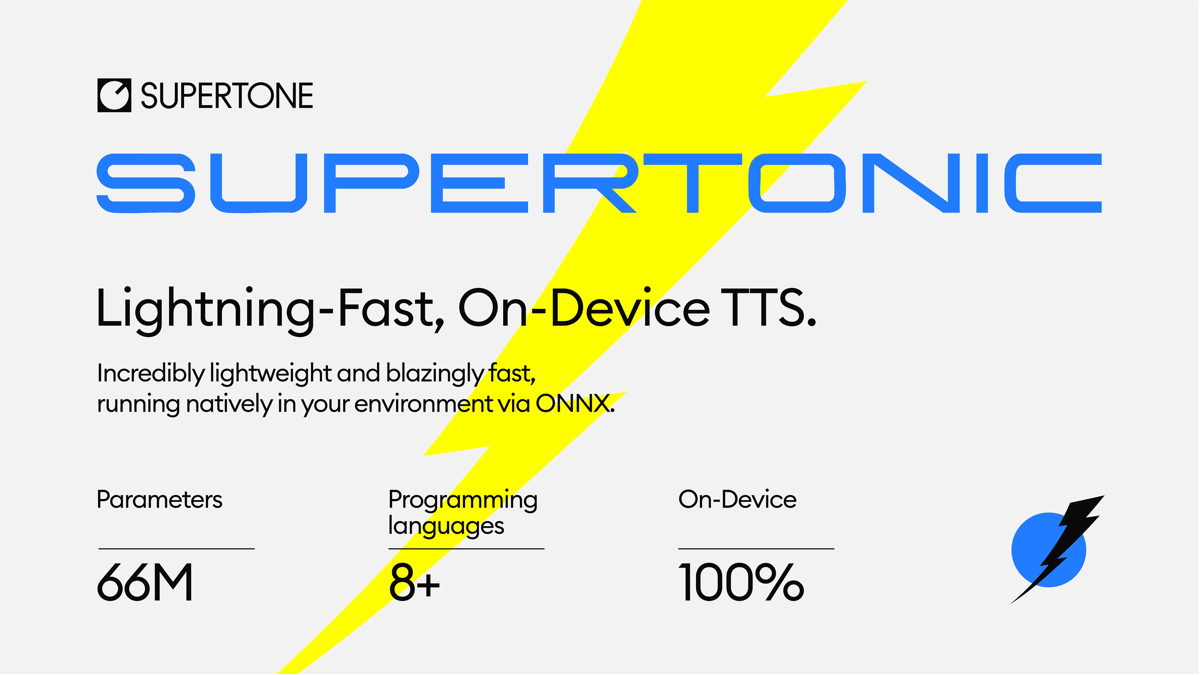
Supertonic is open source, high-performance text-to-speech (TTS) system focused on rapid speech generation on local devices. Using ONNX Runtime technology, it can run on cell phones, computers and even Raspberry Pi and other devices, supports 23 languages and speech clones, and achieves millisecond response without the need for network connection. The feature is the ability to handle complex text, and can naturally read aloud non-standard text containing numbers and symbols, making it suitable for developing real-time voice applications. Users can access the open source code and models via GitHub, with support for Python,Node.jsand many other programming environments.
Features of Supertonic
High quality audio generation: The ability to generate musical, relatively structured, high-quality audio clips from scratch that are not simply melodic snippets.The resulting music is excellent in terms of coherence and listenability, approaching the level of professional production. - Advanced Underlying Architecture: The core is based on MusicGenThe improved model. A single-stage, autoregressive Transformer architecture is used. Uses an efficient tokenization method (e.g., EnCodec) that first compresses the audio into discrete code sequences and then generates based on these codes, greatly reducing the complexity of generation.
- Text description generation: The user can guide the style and content of the music by entering a natural language description (e.g. "a light electronic dance track with a strong bass line").
- Melodic Lead Generation: The user can enter a reference melody (e.g. a hum or MIDI clip), which the model will use as a basis for compositions and variations, and the resulting new music will retain the core features of the original melody. A powerful collaborative tool for music creation.
- Fully open source and customizable: No need to pay for API calls. Runs on its own hardware to protect privacy and data security.
- Fine-tuning customization: Depending on your needs and data, the model is further trained to generate music in a specific style or instrument.
Supertonic's core strengths
Professional-grade listening: The music generated has a high degree of integrity and musicality in terms of melody, harmony, rhythm and instrumental arrangement, and the listening experience is close to that of a professional musician's work, not a simple mechanical loop. - structural coherence: The ability to generate coherent fragments with a certain musical structure (e.g., main song, chorus), not a haphazard stack of notes.
Melodic Lead GenerationThe model can be used to arrange, vary and develop an existing melody (by humming or audio). The user can enter an existing melody (by humming, MIDI file or audio), and the model will use it as the core for arranging, variations and development, resulting in a new piece that perfectly inherits the "soul" of the original melody. - Precise text controlThe understanding of natural language descriptions is precise, and music can be reliably generated to match complex stylistic descriptions such as "exciting symphony" and "relaxing pop piano".
Efficient Computing Performance: The model is optimized to run in real-time on consumer-grade GPUs and even some high-end CPUs, greatly expanding its applicable scenarios and allowing more people to experience and create with a low threshold.
What is Supertonic's official website?
- Github repository:: https://github.com/supertone-inc/supertonic
- HuggingFace Model Library:: https://huggingface.co/Supertone/supertonic
Who is Supertonic for?
- Short video creatorsIndie developers or content creators with limited budgets can generate unique, royalty-free customized soundtracks to match the rhythm of their content, based on game scenes (e.g., "dark forests," "intense battles") or video atmospheres.
- Music creators and composersWhen you encounter a creative bottleneck, you can input a core melodic motif and let the model generate multiple arrangement versions in different styles (e.g. pop, electronic, classical) to quickly expand your creative ideas.
- Music Educators and Enthusiasts: Visualize to students the characteristics of different musical styles (e.g., blues, funk) or demonstrate how a simple melody can be developed into a complete piece through different harmonies and orchestrations.
- Sound Designer & New Media Artist: Quickly generate background tracks and ambient music in various styles and moods as a sound design library.
© Copyright notes
Article copyright AI Sharing Circle All, please do not reproduce without permission.
Related articles

No comments...
 English
  简体中文
简体中文  日本語
日本語  한국어
한국어  Русский
  Español