Qwen-Image-Layered - AI image editing model open-sourced by Ali team

What is Qwen-Image-Layered?
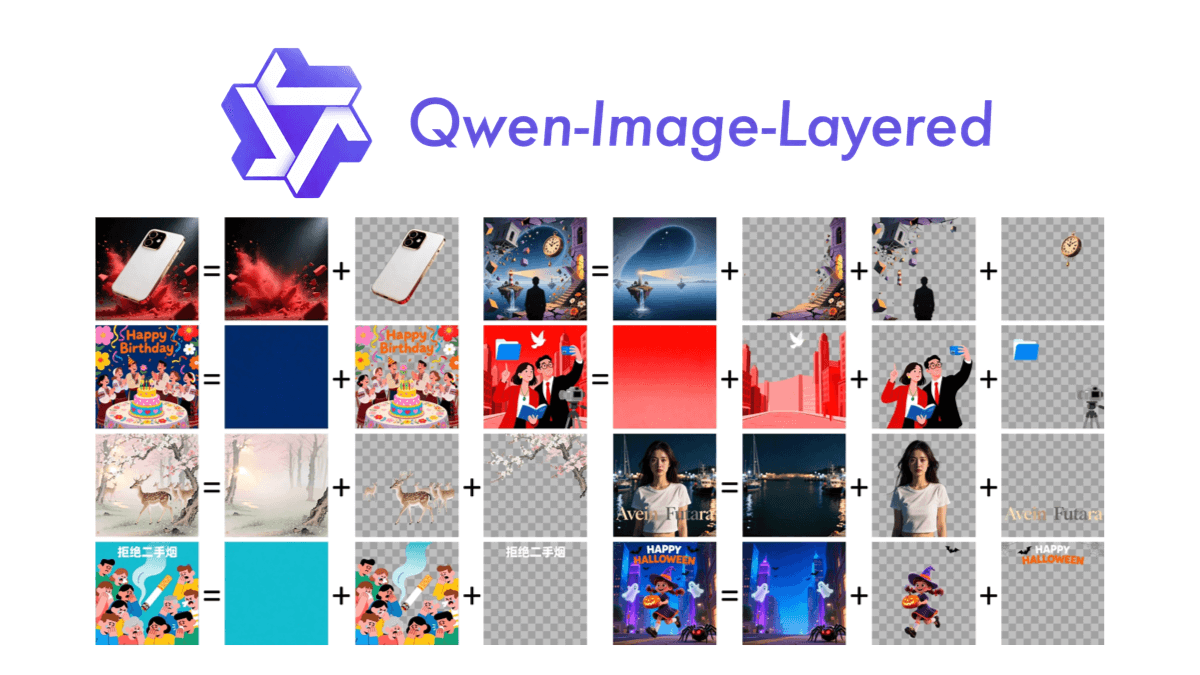
Qwen-Image-Layered is an open source AI image editing model from the Ali team, which can intelligently decompose ordinary images into independent transparent layers to achieve Photoshop-like precision editing. The model is open source using the Apache 2.0 protocol, supports flexible control of the number of layers (3-10 layers), and can infinitely recursively split the details. The core technology includes a unified image-layer translation mechanism, positional encoding and progressive training strategy, which significantly improves the transparency reduction accuracy (0.916). Users can access the GitHubGet the code, or experience the online demo on the Hugging Face platform.
Features of Qwen-Image-Layered
- intrinsic editability: Decompose an image into multiple independent RGBA layers, each of which can be edited individually without affecting the content of the other layers, for highly consistent image editing.
- high fidelity operation: Supports high-fidelity operations on layers, such as clear deletion of objects, distortion-free resizing, free movement of objects, etc., to maintain high quality and consistency of images.
- Flexible layer decomposition: Supports variable number of layer decomposition, users can choose the number of layers to be decomposed according to their needs, and can also recursively decompose any layer to realize unlimited decomposition.
- Powerful Data Pipeline: By extracting and labeling multilayer images from Photoshop documents to build a high-quality training dataset, the problem of scarcity of high-quality multilayer training data is solved, and the training effect of the model is improved.
- Advanced Modeling Architecture: The use of the RGBA-VAE and VLD-MMDiT architectures, combined with a multi-stage training strategy, allows the model to significantly outperform existing methods in terms of image decomposition quality and editing capabilities.
Core Benefits of Qwen-Image-Layered
- Layer Decomposition Editability: After the image is decomposed into multiple independent layers, each layer can be edited independently without affecting each other, which fundamentally ensures the consistency of editing.
- High fidelity operation support: Supports high-fidelity basic operations such as clear deletion, distortion-free resizing and free movement of objects to maintain high image quality.
- Flexible number of layers: Supports variable number of layer decomposition, users can choose the number of decomposed layers according to their needs, to meet the needs of different scenarios.
- Recursive decomposition capability: Any layer can be further decomposed to achieve unlimited decomposition, providing great editing flexibility.
- Efficient data pipelines: Extract multilayer images from Photoshop documents to solve the problem of scarcity of high-quality multilayer training data and improve the model training effect.
- Advanced Modeling Architecture: The RGBA-VAE and VLD-MMDiT architectures, combined with a multi-stage training strategy, significantly improve decomposition quality and editing performance.
- Open Source and Ease of Use: Provides open source code and detailed usage guidelines for developers to quickly get started and integrate into various applications.
What is the official website of Qwen-Image-Layered?
- Github repository:: https://github.com/QwenLM/Qwen-Image-Layered
- HuggingFace Model Library:: https://huggingface.co/Qwen/Qwen-Image-Layered
- arXiv Technical Paper:: https://arxiv.org/pdf/2512.15603
- Online Experience Demo:: https://huggingface.co/spaces/Qwen/Qwen-Image-Layered
Qwen-Image-Layered's Applicable People
- Professional Designer: Complex editing and creative design of images are required, such as advertising design, graphic design, UI/UX design, etc.
- film and television post-producer: Used for special effects processing, element replacement, color correction, etc. in film and television images to enhance work efficiency.
- Creative Artists: The desire to quickly realize creative ideas, to manipulate and combine different elements of an image independently.
- cinematographer: Used for post-editing, such as replacing backgrounds, adjusting the position of the subject, repairing images, etc., to enhance the quality of the work.
- educator: Demonstrate the principles of image decomposition and editing to help students better understand image processing techniques.
- software developer: Integrate Qwen-Image-Layered into image editing software or tools to provide users with even greater functionality.
© Copyright notes
Article copyright AI Sharing Circle All, please do not reproduce without permission.
Related posts

No comments...
 English
  简体中文
简体中文  日本語
日本語  한국어
한국어  Русский
  Español