Omnilingual ASR - Multilingual Speech Recognition Framework from Meta

What is Omnilingual ASR?
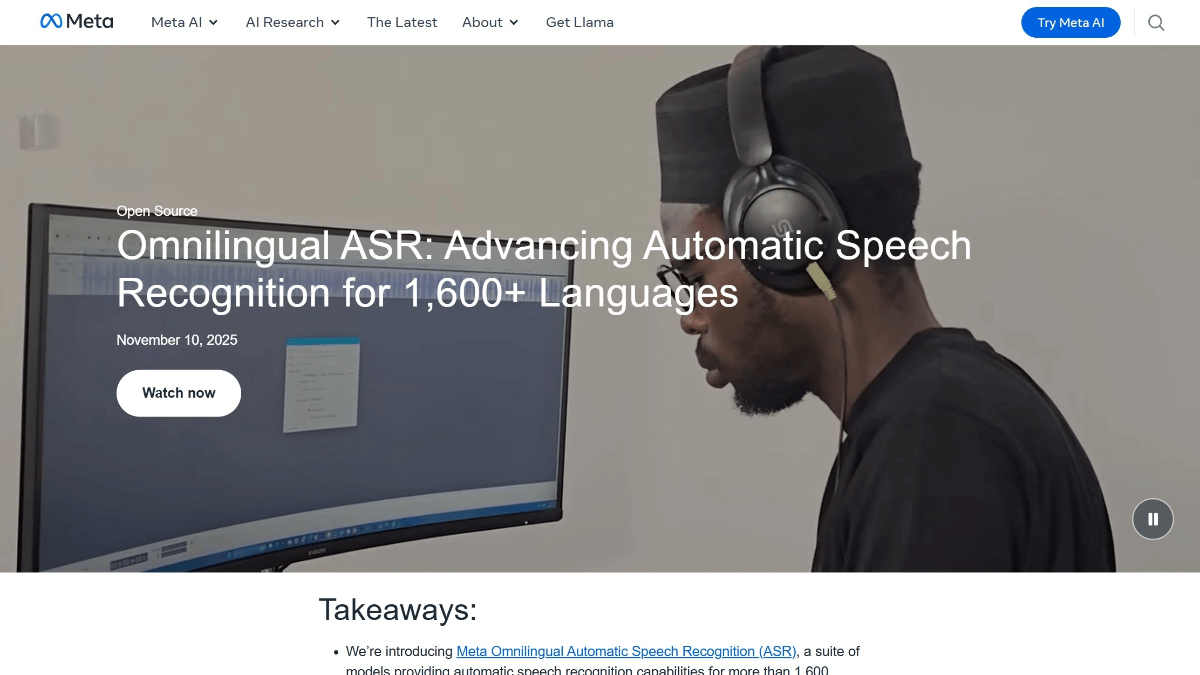
Omnilingual ASR is a multilingual speech recognition framework from Meta, covering 1600+ languages, with 781 TP3T language character error rate lower than 101 TP3T. its 7 billion parameter wav2vec 2.0 encoder combined with CTC and Transformer decoder supports zero-sample transcription of unseen languages, and only a few samples are needed to adapt to the new Language. The model is open-source and contains a corpus of 350 low-resource languages, which promotes the digitization of endangered languages and the universalization of speech technology worldwide.
Features of Omnilingual ASR
- multilingual coverage: Supports more than 1,600 languages, covering a wide range of low-resource and endangered languages, significantly improving the global language coverage of speech recognition.
- Low Resource Language Support: Through self-supervised learning and data enhancement techniques, it effectively solves the problem of sparse data in low-resource languages and reduces the threshold of speech recognition.
- Zero sample learning capability: The ability to transcribe new languages with only a small number of examples, without the need for a large corpus, greatly expands language coverage.
- High Performance ArchitectureThe wav2vec 2.0 encoder combined with CTC and Transformer decoder supports high accuracy and high performance speech recognition.
- Open Source and Collaboration: Open source models and datasets to promote global developers and researchers to work together to advance speech recognition technology and help endangered language preservation.
Core Benefits of Omnilingual ASR
- Extensive language coverage: Supports over 1,600 languages, including a large number of low-resource and endangered languages, significantly improving global language coverage for speech recognition.
- Zero sample learning capability: Transcribing unseen languages with only a few audio and text samples dramatically reduces the cost of developing new languages.
- High Performance Architecture: A 7 billion parameter wav2vec 2.0 encoder and an advanced decoder are used, combined with self-supervised learning, to achieve high-precision speech recognition.
- Open Source and Community Support: Open source of models and datasets to promote the participation of developers and researchers around the world to advance technology development and language preservation.
- Innovative data enhancement technology: Solve the problem of sparse low-resource linguistic data through techniques such as synthesized speech to improve the generalization ability of the model.
- Flexible decoder selection: Provides both CTC and Transformer decoder options to meet the performance and efficiency needs of different scenarios.
What is Omnilingual ASR's official website?
- Project website:: https://ai.meta.com/blog/omnilingual-asr-advancing-automatic-speech-recognition/
- GitHub repository:: https://github.com/facebookresearch/omnilingual-asr
- HuggingFace Model Library:: https://huggingface.co/datasets/facebook/omnilingual-asr-corpus
- Technical Papers:: https://ai.meta.com/research/publications/omnilingual-asr-open-source-multilingual-speech-recognition-for-1600-languages/
Who Omnilingual ASR is for
- language researcher: It can be used to study low-resource and endangered languages and help language preservation and linguistic research.
- Technology Developer: Suitable for developing speech recognition applications that take advantage of its open source nature for secondary development and integration.
- content creator: Facilitate the production of multilingual audio and video content, enabling fast transcription and subtitle generation.
- educator: To help develop multilingual educational resources to support language teaching and intercultural communication.
- business user: Suitable for enterprises that require multi-language speech recognition services, such as customer service, meeting recording and other scenarios.
- Community and non-profit organizations: Can be used to support linguistic diversity programs and to promote cultural exchange and language preservation.
© Copyright notes
Article copyright AI Sharing Circle All, please do not reproduce without permission.
Related posts


No comments...
 English
  简体中文
简体中文  日本語
日本語  한국어
한국어  Русский
  Español