EverMemOS - Open Source Long-Term Memory Operating System by Team Shanda

What is EverMemOS
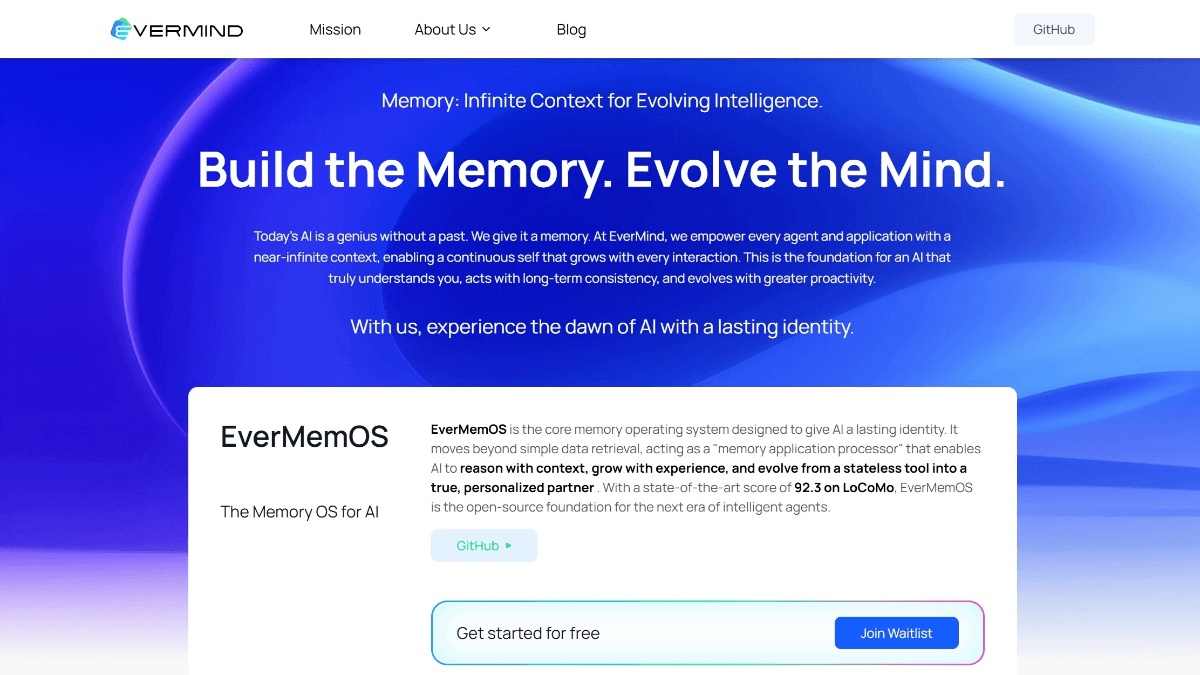
EverMemOS is an open source long-term memory operating system launched by the Shanda team led by Chen Tianqiao, designed for AI intelligences to solve the problem of memory breakage caused by the fixed context window of large language models. The system is based on the memory mechanism of the human brain and adopts a four-layer architecture (agent layer, memory layer, index layer, interface layer), and has surpassed the industry benchmarks with high scores of 92.3% and 82% in the LoCoMo and LongMemEval-S evaluations. Its innovations include layered memory extraction technology, dynamic organization of memory units, and support for 1-to-1 conversations and multi-person collaboration scenarios.
Features of EverMemOS
- Structured memory management: Converting conversations and information into structured Memory Cells (MemCells) for efficient memory storage and retrieval.
- Multi-scene memory synergy: Supports the collaborative management of dynamic memories (e.g., real-time conversations) and static memories (e.g., documents, knowledge bases), adapting to the diverse needs of individuals and teams.
- Active Intelligence and Reasoning: Have the ability to proactively identify problems, advance decisions, and follow through on implementation, discovering deep knowledge relationships through multi-hop reasoning across complex information links.
- Multi-model integration: Incorporate Retrieval Augmented Generation (RAG), Vector Retrieval, Knowledge Graph and other technologies, integrate multiple mainstream big models, and intelligently select the optimal AI capability.
- memory portabilityThe user can export all data and knowledge at any time, ensuring data portability and security, and avoiding data "kidnapping".
- Flexible Architecture DesignIt adopts layered architecture and supports modularization and expansion, and can flexibly adapt to different business scenarios and needs.
- Open Source and Openness: The open source version supports developers and AI teams in deployments and trials, fostering community innovation and ecological development.
Core Benefits of EverMemOS
- Efficient Memory Management: Efficient information storage and retrieval through structured MemCells and hierarchical architecture to ensure memory accuracy and coherence.
- Multi-scenario adaptability: It supports the collaborative management of dynamic and static memories, individual and team memories, and meets the diversified needs in different scenarios.
- active intelligence capability: Ability to proactively identify problems, advance decisions and follow through on implementation, discovering deep knowledge relationships through multi-hop reasoning.
- Technology integration and innovation: Incorporating technologies such as retrieval-enhanced generation (RAG), vector retrieval, and knowledge graphs, it integrates a variety of mainstream big models to provide more powerful AI capabilities.
- Data Security and Portability: Users can export all data and knowledge at any time, ensuring data portability and security.
- Open Source and Open Ecology: The open source version supports developers and AI teams in deployments and trials, fostering community innovation and ecological development.
- Enhancing the user experience: Enhance the AI interaction experience through memory management, transforming AI from a tool to an intelligent body, providing a more natural and coherent dialog experience.
- High Score Review Performance: Achieved a high score of 92.31 TP3T on the Long-Term Memory Review set LoCoMo, significantly exceeding the current level.
What is the official website for EverMemOS
- Project website:: https://evermind-ai.com/
- Github repository:: https://github.com/EverMind-AI/EverMemOS/
Who EverMemOS is for
- Corporate Team: Enterprise teams that need to collaborate and manage knowledge efficiently, with integrated tools like Slack, Gmail, Notion, and more.
- individual user: Users who wish to improve their personal knowledge management skills for organizing fragmented information, managing study notes and ideas.
- research worker: Researchers who need to manage large amounts of data and research notes to improve research efficiency through memory management.
- Educators and students: For recording the learning process, organizing knowledge points, and improving teaching and learning efficiency.
- content creator: Creators who need to manage inspiration and creative material, assisting in generating content and improving creative efficiency.
- Customer Service Team: Customer service teams that need to quickly retrieve historical conversation records and provide accurate service.
© Copyright notes
Article copyright AI Sharing Circle All, please do not reproduce without permission.
Related posts

No comments...
 English
  简体中文
简体中文  日本語
日本語  한국어
한국어  Русский
  Español